Wednesday, 7 September 2016

How to seduce a bee (as an orchid)

missing
Figure 1: Plant and pollinator. Insects spread plants' genetic material (pollen) from flower to flower in exchange for a sugar (nectar) reward.
Flowing plant reproduction - Imagine that you are a plant, rooted in the ground, and it's that time of year when you want to spread your genetic material to other plants to reproduce. You can't walk around to find a mate, so what do you do? Some plants solve this problem by allowing wind to carry their pollen in vast plumes across the landscape, hoping that it will reach the flowers of other members of the same species. However, many other plant species have stumbled upon a fortuitous partnership with bees, butterflies, and other insects that directly carry plant pollen from one flower to another.

Flowering plants work with pollinators to reproduce - Pollen-spreading insects (pollinators) make plant reproduction very efficient. Plants that recruit pollinators have been very successful - they are now the most common plants on earth. Some relationships between flowering plants and pollinators are specialized, so that only certain pollinators may spread the pollen of a certain plant species. Other relationships are general, so a single plant species is compatible with many pollinator species. In either case, plants often provide a sugary reward (nectar) for insects transferring pollen from one plant to another, which many insects and even some birds use as a primary resource (Figure 1).

missing
Figure 2: Some flowers attract male bees to be pollinators by looking and smelling like female bees. Instead of providing a nectar reward to attract pollinators, some flowers develop to look like female bees. These flowers also release bee sex pheromones into the air to attract nearby male bees. By moving from one deceptive flower to another, male bees transfer the plants' pollen. Photo used with the permission of Carlos Enrique Hermosilla (https://www.flickr.com/photos/26925527@N07/)
Some flowers attract pollinators with pheromones - Some plant species are able to get bees to collect and spread their pollen without providing a reward. In the orchid family, a plant family with a tremendous number of species, some species produce flowers that look like female bees. These flowers entice male bees to land, pick up pollen while they wiggle around, and then carry it away while in search of a mate with a heartbeat (Figure 2). In doing this, male bees transfer pollen from one flower to another. To encourage male pollinators to land on these deceptive flowers, these plants scent the surrounding air with aphrodisiacs - bee sex pheromones that draw the male bees in with great effect. This is where chemistry comes into play!

Figure 3: Scents produced by flowers can attract specific pollinator species. The flowers of different plant species can produce different mixtures of scents, in some cases insect sex pheromones, to attract pollinators (top panels). Depending on the specific pheromones produced, different insect species may be attracted (middle and lower panels).

Deceptive pheromones are species-specific - There is a great variety of chemical compounds that plants use as deceptive pheromones with which to attract bees, and in many cases these chemical compounds are species specific [1]. For example, the orchid Ophrys exaltata attracts the bee Colletes cunicularius by producing a specific type of chemical called a 7-alkene. In contrast, Ophrys sphegodes attracts Andrena nigroaenea with 9-, 11-, and 12-alkenes (Figure 3). Even though these pheromones are extremely similar (they only differ in the position of their carbon-carbon double bond), adding the pheromones of one orchid species to the flower of the other creates a mixture that neither bee species is attracted to [2]. Overall, the exact identity and proportions of the different chemical compounds that flowers produce to attract pollinators is important [4].

Deceiving pollinators may encourage speciation- Let's perform a thought experiment - if an O. sphegodes plant acquired a mutation that caused it to only produce two of its three alkenes, we know it would probably not attract either C. cunicularius or A. nigroaenea. But, if there were another insect species nearby that was attracted by the two alkenes alone, then the mutant plant could still survive. Over time, the offspring of the mutant plant could become a population of individuals all carrying the mutation and producing only two alkenes. Perhaps the flowers of these mutants would also change shape or color over generations so as to more effectively attract the new insect pollinators. Eventually, this could lead these mutants to become an entirely different species!

So, in addition to being crucial for the reproduction of some flowering plant species, scientists think that specificity in plant-pollinator relationships is a substantial driving force in speciation, perhaps occurring via a process similar to that described above [5, 6]. Flowers make fragrances to do more than just smell nice!

[1] Bjorn Bohman, Gavin R Flematti, Russell A Barrow, Eran Pichersky and Rod Peakall. Pollination by sexual deception — it takes chemistry to work. Current Opinion in Plant Biology 2016, 32:37–46
[2] Xu S, Schluter PM, Grossniklaus U, Schiestl FP: The genetic basis of pollinator adaptation in a sexually deceptive orchid. PLOS Genet 2012:8.

[3] Bohman B, Philips RD, Menz MHM, Berntsson BW, Flematti GR, Barrow RA, Dixon KW, Peakall R. Discovery of pyrazines as pollinator sex pheromones and orchid semiochemicals: implications for the evolution of sexual deception. New Phytol 2014, 203:939-952.
[4] Bohman B, Karton A, Dixon RCM, Barrow RA, Peakall R. Parapheromones for thynnine wasps. J Chem Ecol 2016, 42:17-23.
[5] Peakall R, Whitehead MR: Floral odour chemistry defines species boundaries and underpins strong reproductive isolation in sexually deceptive orchids. Ann Bot 2014, 113:341-355.
[6] Xu S, Schluter PM, Grossniklaus U, Schiestl FP: The genetic basis of pollinator adaptation in a sexually deceptive orchid. PLOS Genet 2012:8.

Monday, 1 August 2016

Blue Hydrangeas – How and WHY!?

missing
Figure 1: Yellowing tomato leaves. Leaves turning yellow or brown can be caused by numerous stresses on the plant.
This story is about hydrangeas – I promise! – but it begins with tomatoes. This week the leaves of the tomato plants in our garden began to turn yellow (Figure 1). Why does this happen? Leaves are normally green because of chlorophyll, the light-collecting compound that is highly abundant in most plant cells. So, though yellow leaves might be caused by many factors, it could mean the plant is losing its ability to produce chlorophyll.

Chlorophyll is made of carbon, hydrogen, oxygen, nitrogen, and magnesium (Figure 2). It seems unlikely that our tomatoes are suffering from a shortage of carbon, hydrogen, or oxygen, since they get these from the CO2 in the air and water we give them. Therefore it might be that a nitrogen or magnesium shortage is leading to leaf yellowing, and that our tomatoes need these elements added to their soil.

missing
Figure 2: Chemical structure of the chlorophyll molecule. The chlorophyll molecule has three principal components, the carbon chain (bottom left), the ring structure (right), and the magnesium metal atom (in green). Magnesium deficiency can lead to decreased production of chlorophyll in plant cells.
The elements nitrogen and magnesium are among six nutrients that plants need in substantial amounts. These macronutrients are the elements nitrogen (N) and phosphorous (P), and the metal elements potassium (K), calcium (Ca), sulfur (S), and magnesium (Mg). These are all essential for plant health and are acquired through roots. Other elements are needed in only very small amounts. These micronutrients are boron (B), chlorine (Cl), and the metals manganese (Mn), iron (Fe), zinc (Zn), copper (Cu), molybdenum (Mo), and nickel (Ni).

Not all metals are required for plant health, and some are even detrimental. For example, aluminum, the most abundant metal in the earth's crust, can inhibit root absorption of magnesium, the metal in chlorophyll, causing the plant to experience magnesium deficiency. In soils with low acidity, called basic soils, aluminum is bound to the soil and does not interfere with the plant. However, in acidic soils aluminum is released from the soil and gets stuck in root channels that normally absorb magnesium, inhibiting the absorption of Mg. In this way aluminum is toxic to many plants that grow in acidic soils.

missing
Figure 3: Color change in Hydrangea macrophylla. Top: delphinidin in its normal state leads to blue colored hydrangea petals. Bottom: delphinidin bound with aluminum (a delphinidin-aluminum complex) leads to petals with red or pink color.
Some plant species have evolved mechanisms to reduce the toxicity of aluminum. Citric acid is released from the roots and binds to the aluminum, allowing the aluminum to be absorbed into the roots and transported up into areas of the plant where it will not interfere with the absorption of magnesium [1]. Many of us are probably familiar with one species of aluminum-tolerant plant – Hydrangeas (Hydrangea macrophylla in particular). This species has flowers that are normally red or pink because they contain a phytochemical called delphinidin (Figure 3). When there is aluminum present in the soil the Hydrangea releases citric acid to bind the aluminum and then absorbs the bound aluminum and transports it to the flowers for storage. Here the aluminum interacts with the red delphinidin pigment and transforms it into a blue pigment, and causing the flowers to turn blue [2]. Thus, when Hydrangea macrophylla is exposed to acidic, aluminum-rich soils, its flowers turn from red to blue!


It is remarkable that ingredients as simple as aluminum and acid can cause such a dramatic change in flower color. It is even more amazing that this phenomenon is no accident but is a clever strategy used by the plant to prevent aluminum from interfering with magnesium uptake. Maybe someday tomato plants will also develop a similar mechanism and prevent aluminum from inhibiting magnesium uptake, allowing them to thrive in a wider diversity of soils.


[1] Jian Feng Ma, Syuntaro Hiradate, Kyosuke Nomoto, Takasi Iwashita, and Hideaki Matsumotol (1997). Interna1 Detoxification Mechanism of AI in Hydrangea, ldentification of AI Form in the Leaves. Plant Physiology 113: 1033-1039.
[2] Henry D. Schreiber, Amy M. Swink, Taylor D. Godsey (2010). The chemical mechanism for Al3+ complexing with delphinidin: A model for the bluing of hydrangea sepals. Journal of Inorganic Biochemistry 104: 732–739.

Saturday, 16 July 2016

Are apple seeds poisonous? – plant cyanogenic compounds

missing
Figure 1: Apple and seeds. Seeds of the common apple contain the ingredients for producing hydrogen cyanide as a mechanism to deter other organisms from eating the seeds.
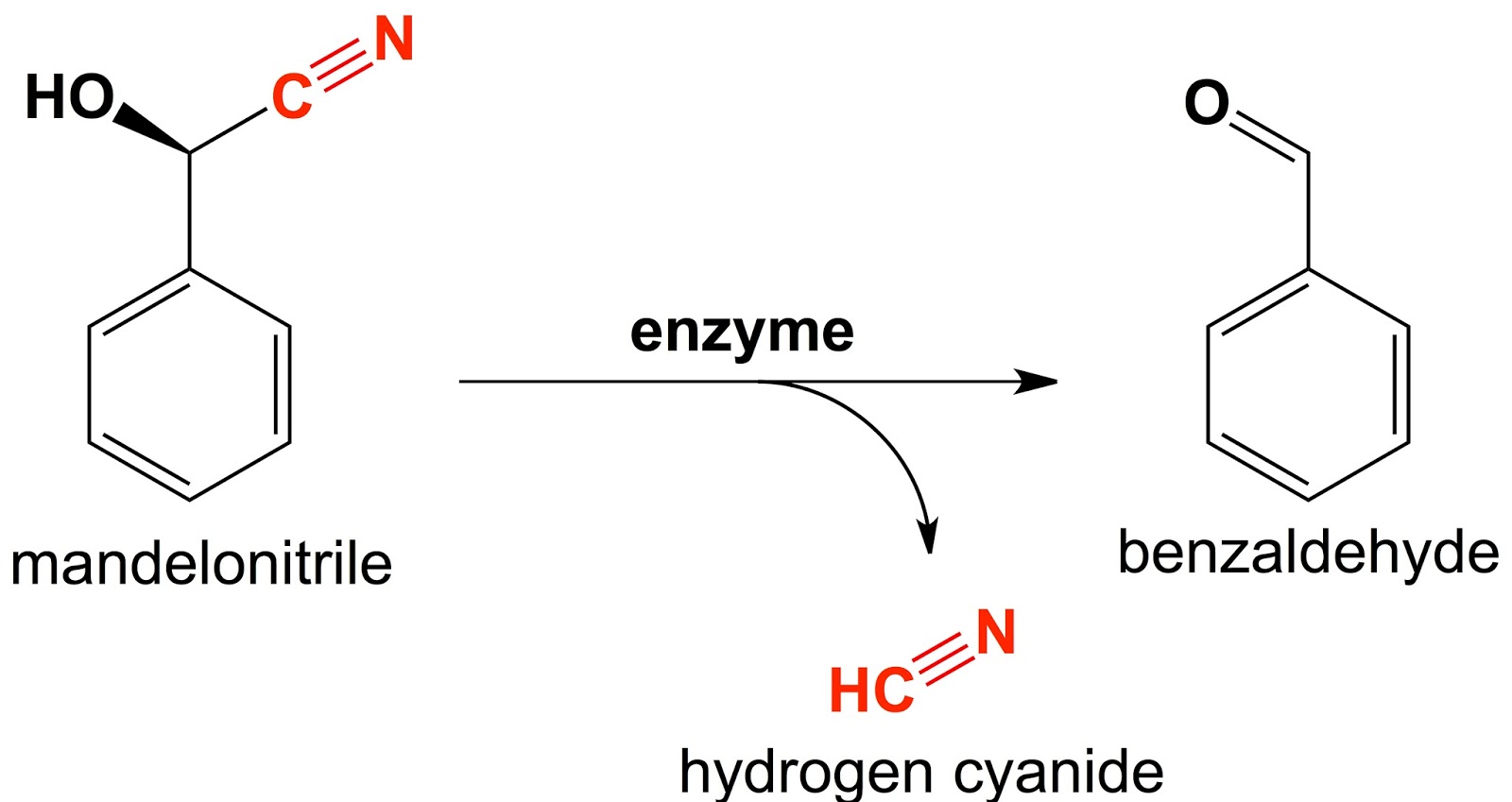
Plants are anchored in the ground and cannot run away when attacked, but they do not meekly allow themselves to be eaten! In many cases, plants that do not want to be eaten have developed complex chemical mechanisms that deter, distract, and even poison attackers. Many different plant poisons have been identified, but one of them is hydrogen cyanide - a poison that inhibits respiration. So far, more than 3000 species of plants have been identified that are capable of generating hydrogen cyanide to punish organisms that eat their leaves. The common apple is among these plants (Figure 1) [1]. These plants produce cyanide-containing molecules called cyanogenic compounds, for example, mandelonitrile (Figure 2).

Cyanogenic compounds (cyanogens) are inactive and generally not poisonous, so plants can produce and store them in special compartments inside their cells without causing themselves harm. In nearby but separate compartments, plants also store a special enzyme capable of transforming the inactive cyanogen into toxic hydrogen cyanide. Then, when insects or other animals bite down on the leaves of the plant, the compartments' walls are crushed, mixing the cyanogen with the enzyme and releasing toxic hydrogen cyanide right inside the attacker's mouth!

missing
Figure 2: Enzymatic activation of cyanogens. Mandelonitrile (a specific cyanogen) can be enzymatically converted into benzaldehyde (a side product) and active hydrogen cyanide.
Plants produce and store cyanogens in many forms. Oftentimes they are stored linked with sugar molecules like glucose, in which case they are called cyanogenic glycosides. These are found in the seeds of many fruits in the rose family, like apples, plums, apricots, and peaches, but only in relatively small amounts. In small amounts, these seeds are not harmful to humans - so don't worry about eating a few apple seeds!

Cassava roots, a staple food in many African, Asian, and Latin American countries [2], contain substantial amounts of cyanogenic glycosides (Figure 3) [3]. Accordingly, cassava roots need to be processed before consumption. One method of doing this is to grind the cassava, exposing the activating enzyme to the cyanogenic glycosides, spreading the paste in a thin layer to allow it to dry. Once released, active hydrogen cyanide has a low boiling point, so much of it evaporates quickly and the cassava becomes safer to consume.

missing
Figure 3: Cassava roots contain cyanogens that must be removed prior to human consumption. Grinding the roots and allowing active hydrogen cyanide to evaporate makes cassava safer to eat. This image is in the public domain.
Cyanogens are currently being tested as alternatives to synthetic pesticides for specific applications. For example, approximately 25% of a wheat crop is lost to pests (rats, mice, insects, etc.) over the course of the agricultural process, with substantial losses occurring when the seeds are being stored prior to planting [4]. Synthetic pesticides are often applied to minimize these losses, but but we are learning that pesticides often have detrimental effects on nearby water sources and can be difficult to control when washed away by rain.

In response to the shortcomings of synthetic pesticides, materials chemists, inspired by cyanogens in nature, have invented a new coating that can applied to wheat seeds in storage. The seeds are coated with an enzyme, then a thin barrier, then a cyanogen [5]. When the barrier is ruptured by pests, the enzyme and cyanogen mix, releasing hydrogen cyanide. Such seeds are less prone to attack during the pre-planting phase of the agricultural process. While this application is still in developmental phases and is undergoing testing to determine its environmental and ecological effects, it is a step towards the protection of crops with naturally occurring, biodegradable materials.

Plant cyanogens are just one example of naturally occurring compounds that are useful to humans. The "2016 State of the World's Plants" report by the Royal Kew Gardens indicates that over 30,000 species of plants are useful to man. For example, over 5,000 feed us, 17,000 provide us with medicine, and 1,600 provide us with sources of fuel. Unstudied and unknown species hold chemical secrets that promise to aid humans in the future - these warrant study and exploration.


[1] Poulton, J.E., 1990. Cyanogenesis in plants. Plant Physiology, 94(2), pp.401-405.
[2] Food and Agriculture Organization. http://www.fao.org/ag/agp/agpc/gcds/
[3] Banea-Mayambu JP, Tylleskar T, Gitebo N, Matadi N, Gebre-Medhin M, Rosling H. (1997). Geographical and seasonal association between linamarin and cyanide exposure from cassava and the upper motor neurone disease konzo in former Zaire. Trop Med Int Health 2(12):1143-51]
[4] Encyclopedia of Pest Management, ed. D. Pimentel, CRC Press, 2002.
[5] Jonas G. Halter, Weida D. Chen, Nora Hild, Carlos A. Mora, Philipp R. Stoessel, Fabian M. Koehler, Robert N. Grass and Wendelin J. Stark (2014). Induced cyanogenesis from hydroxynitrile lyase and mandelonitrile on wheat with polylactic acid multilayer-coating produces self-defending seeds. J. Mater. Chem. A, 2: 853